Category: The Electronic Corner

Grey Gallows interview intervista

Grey Gallows Interview

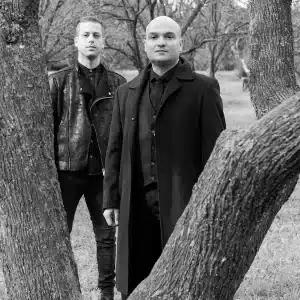
THE ELECTRONIC CORNER Grey Gallows A Journey From Darkness to Light in Music and Lyrics Grey Gallows say: Dark times help us strenghten ourselves Nick knows precisely how to reproduce the analog sounds of the 80s and 90s that we want We consider ourselves a guitar-driven band The Korg Minilogue is my favorite synth Konstantin is the vocalist / keyboard player of Grey Gallows, a dark wave duo from Patra, Greece. In this interview for ‘The Electronic Corner’, we had a lovely conversation, not only about music but also about the importance of hardships in life. Sir Joe: Please tell us about the formation of the band in 2016, and what inspired you and Dionisis to start making music together. Grey Gallows: Well, I met Dionisis in 2013, I think, and we became friends because we had many things in common; not only music, but also the same perception of life.We used to hang out in various clubs, particularly those that played rock or goth music. As we listened to the music, we would have discussions and it was during one of these that we realized that we shared a dream: to form our own band.We wanted to create our own music and write songs that reflected our experiences and influences. This was one of my earliest dreams – to have my own band, not just to play in one where I was performing someone else’s ideas.This common dream brought us together and we decided then and there to try and make our band a reality.   SJ: That’s great. Now, let’s talk about your lyrics, which deal with issues from inner struggle to healing from dark emotions.Can you share more about your songwriting process and how you approach these themes?   Grey Gallows: Indeed, as you mentioned, our lyrics delve into the experience of pain and the healing process that follows.This is similar to exploring the dark side of the moon. As we journey through our pain, we gain wisdom and maturity, and at the end of this journey, we find light.It’s a journey about self-understanding and it encompasses both dark and light times, symbolized by the colors black and white.This is why we chose the name Grey Gallows for our band. The gallows represent a negative image, a time of hanging in uncertainty. The color grey is a blend of black and white, symbolizing the mix of dark and light times we all experience in life, those experiences that propel us forward.In terms of our songwriting process, either Dionisis or I come up with a basic structure or idea. We don’t typically write songs in the studio or live. Instead, one of us will develop a basic idea and then share it with the other.Once the main idea is fleshed out, we write the lyrics. I try to create a vocal melody for these lyrics, which I’ve found is similar to creating a melody for an instrument. The human voice is basically just another instrument.So, our lyrics reflect this struggle with dark emotions and our name embodies this journey from darkness to light. SJ: What you just said about the darkness and light in our life and the fact that both are needed in order to move forward makes me think of a quote from one of my favorite authors.His name is Neale Donald Walsh, and he keeps saying that the only way for us to know what we like is when we are exposed to what we don’t like. Life as eternal happiness is an impossible condition, because you can find out what you want only when you can also see what you don’t want.So, I was wondering if you agree with this kind of philosophy, since it seems to be aligned with the way you write your lyrics. Grey Gallows: Well, it’s an amazing quote, and I agree 100% with it. When I heard you say those words, I thought about a situation most of us have to face in life.As a young person, it often felt overwhelming to face difficult situations or dark emotions. I even believed that I would have never been able to handle such challenges.However, as we grow older and accumulate more life experiences, our perspective often changes. We come to realize that those difficult times, as painful as they were, are valuable. They’re part of our unique experience and have shaped us into who we are today.These dark times not only help us strengthen ourselves but also equip us to face potential challenges in the future.So, in retrospect, these times are not just precious, they are needed, necessary for our lives. We cannot continue our lives without experiencing those precious moments. SJ: Moving back to your band, how did your music evolve, since your first mini album ‘Beyond Reflections’?   Grey Gallows: Our music is constantly evolving and developing.Our first mini album, ‘Beyond Reflections,’ was recorded in the last months of 2016. At that time, we had a few ideas and a strong desire to bring those songs to life.As you can imagine, it wasn’t as professional as it could have been, because we were a very underground band. Even now, we’re still underground and not mainstream, but back then we didn’t even have the tools or a sound producer, and all the production was done by Dionisis in his home studio.The instruments were primarily VSTs played by Dionisis, like the Minimoog, or the Jupiter VST, while I was playing the Roland Fantom, a fantastic digital synthesizer.At that time, I didn’t use VSTs for arpeggios, but I was tapping the keyboard to stay on tempo, which was a tiring process. After that experience, we started using more VSTs.Over the years, we’ve invested in various VSTs and analog synthesizers. Our aim has been to create a blend of both hardware, specifically analog synthesizers, and software digital synthesizers, which add different layers to our music. SJ: Starting with very basic equipment was indeed a formative experience for you, wasn’t it?I mean, perhaps if

Leggi Tutto »
AshRamus interview

AshRamus Interview

THE ELECTRONIC CORNER AshRamus Norway, Underwater World, Ambient Soundscapes AshRamus says: My music videos are all filmed through my windows I don’t do cuttings, I don’t do mixings I was kicked out from the orchestra a couple of times All my songs are made of two or sometimes three tracks In this interview for ‘The Electronic Corner’, we dive deep into the fascinating world of ambient music with our special guest, AshRamus. Sir Joe: Your artist name sounds very esotheric to me, and fits perfectly with the kind of music you play. I thought it was made up, but actually it comes from Ash Ramus, which in Lithuanian means “I’m calm”.Besides the name, have you brought something else in your music from your country of origin? AshRamus: You know, it’s very difficult to say. I was in music school from the age of 7. I used to play clarinet, trumpet, a little bit of piano and the harmonium.I played for many years in an orchestra, doing concerts and a lot of funeral processions. In the old days it was common practice, with the orchestra being in front and playing for the last journey of a person.Nowadays, though, nobody does it anymore. These are the music memories I have of Lithuania.   SJ: How about Norway, since you now live in that country?Geir Jensen, my favorite ambient musician who mostly records under the artist names ‘Biophere’, claimed in an interview that growing in Tromsø had indeed an impact on his composition ideas.Is it the same for you?   AshRamus: Yes, indeed! I have a two floor house, and sometime ago I had moved the studio in the first floor.However, you see only trees from there, while from the windows upstairs you see the mountains, with the snow on them and around.If you watch my music videos, they are all filmed through my windows, so I don’t need to go out somewhere to get a visual inspiration.The same goes with music. Because of lack of inspiration on the first floor, I moved the studio back to the 2nd floor.Nature in fact plays a very important role in my music. When I see clouds over the mountains, for example, I get inspired and I start playing.That’s how my music is born. I don’t do cuttings, I don’t do mixings, I play three, five, sometimes 10 hours, then I just keep small parts that I like. SJ: I have a question about that later, actually, but now I would like to ask you this: Your life seems to be running in cycles of 10 years.You studied and played music for 10 years, as you already mentioned, then you were in the military sector for 10 years, then in the constrution business, then you were a diver, also for 10 years and now you are a musician again.I’m not so sure about military and construction, but in my mind diving and ambient music are a great match, so I was wondering if your activity as a diver had an influence in the kind of music you propose. AshRamus: First, I want to tell you that I used to travel a lot in India, in the Himalayas, spending up to six months alone, just walking through the various mountains.When you do something like that, you get into a state of being one with nature, a sort of meditative state.With diving, it’s the same, you know. You need to practice a lot and exercise, to be a good diver, but in order to meditate with diving you just dive, you become one with the water and there you go, you are already meditating.Underwater, you are in another world, in another space and you don’t need to practice a lot to get in the meditative state, you just need to dive.   SJ: That is so true!Now, an ambient song, by its nature, relies more on creating a flow than on fixed parameters like verse, chorus, verse, chorus and so on.For me it would be difficult to decide when a song is finished, because of the risk of letting it go endlessly.How do you face this challenge? I’m asking also because some of your tracks last more than 10 minutes…   AshRamus: As I said before, when I play, I do it for many hours and sometimes I feel that what I saved is too short, so I keep a bit more material.All people then have a different perception of music, so for some a track may sound too short and for others too long.It’s like when you play a computer game that you like a lot: in that case time goes fast, then, you sit in the room alone without any computer or anything, and time goes slow. The same happens with music. SJ: Indeed.Next question: Sound design is very important in ambient music because it’s essential to create an atmosphere, even more than with other genre of music.Do you have any favorite techniques or tools when it comes to sound design for your songs? AshRamus: I use mostly a sequencer and a midi controller, to make music.So, for example, I may play some simple notes on it, and then the signal goes to my analog polyphonic synthesizer.I also have another sound machine, an old Korg which has lots of effects, drums and some orchestral sounds. So, I create a simple melody in a small synth, play it as a loop and play along with my polyphonic synthesizer, non-stop.   SJ: I understand, but do you use preset sounds, or you do you create your own sounds starting from a preset, for example? AshRamus: Usually I start from a preset in my analog synthesizer, and then I modify its oscillators, I use filters and so on.Starting from a preset saves a lot of time, because you don’t have to worry about things like aftertouch, for example, which usually is part of the preset.   SJ: Which of your machines is your favorite and why? AshRamus: I think

Leggi Tutto »
Preemptive Strike 0.1

Preemptive Strike 0.1 Interview

THE ELECTRONIC CORNER Preemptive Strike 0.1 Behind the EBM Scene: Creative Process, Gear and Much More Jim The Blaster (Preemptive Strike 0.1) says: At the end of October 2023 we will release a new album I have to admit that now young people prefer Spotify Playing EBM is a way to release anger and dark feelings The Cretan lyra is a very difficult instrument to record Jim The Blaster is one half of Preemptive Strike 0.1, a Greek EBM band with more than 20 years experience. Let’s discover some of the secrets of their longevity in this interview for ‘The Electronic Corner’. Sir Joe: What is the meaning of that 0.1 after Preemptive Strike? Jim The Blaster: First, I would like to explain what a preemptive strike is. Basically, it’s an attack against an enemy in response to an obvious threat. Since you are afraid of a potential attack, you act first through a preemptive strike. 20 years ago, when we were looking for a name for our band, we opted for Preemptive Strike, but we thought that maybe there was already a band with the same name. Indeed there was, a punk band to be precise, so we had to add something to make our name unique, and we went for 0.1. It means two things: The first meaning is that it’s the 1st strike, and the second has to do with the binary language of computers … you know, 01010101 and so on.   SJ: Your latest full album was released in 2019. Then, you released a mini cd in 2020, a cassette with 6 tracks in 2021 and 2 digital singles in 2023. Can we expect a new album soon? Jim The Blaster: I’m very happy to announce that at the end of October 2023 we will release a new album, called ‘Defense Readiness Condition One’, for the German label ‘Infacted Recordings’. The release of the two singles was a request from this record company. SJ: Speaking of these two singles, they see a collaboration with Paradox Obscur. Can you tell us about the origin of this collaboration? Who contacted who, and so on? Jim The Blaster: I met Kostas for the first time 8 years ago, at one of our gigs. Then I learned about all his projects and, to me, Paradox Obscur is the best one. When last summer (2022) we decided to use some female vocals in one of our tracks, we thought about Kriistal Ann, so I sent Kostas a message telling him that we needed some guest vocals. Ann accepted, and it worked perfectly. Then, at the end of the year we signed for ‘Infacted Recordings’, and when they asked us for an additional single, besides the one we did with Ann, I thought again about Paradox Obscur. So, I contacted Kostas again and asked him if he would be interested in making a remix for us. He accepted and, as I expected, he did the remix the old school away, using only hardware and my vocals, nothing else. He told me that he pressed ‘record’ and let all the machines play at the same time, with my voice. That’s how he recorded the remix, and I’m extremely happy with the result, because it’s something unique. So, I’m very satisfied with this collaboration, and from time to time I still contact him, since now we are friends.   SJ: Is your collaboration with Dimitris Douvras and Vlad McNeally still going on?   Jim The Blaster: No. Dimitris was our producer since the beginning, until 2019. Then, production, mixing and mastering were transferred to Yiannis, my partner in the band. He’s a sound engineer as well, and he has all the proper tools to take care of production. He doesn’t use only a computer, but also many machines. About Vlad McNeally, to me he is the best designer in the whole scene, because whatever you have in your mind for the front cover, he is able to do it for you. Infacted Recordings has its own designer, just as Vlad works for our previous label, so he made the cover of our latest release. Anyway, both Dimitris and Vlad are the best in their field. SJ: Some years ago the band’s opinion about Spotify and streaming platforms in general was not very positive. Have you changed your mind in the meantime? Jim The Blaster: Well, as a fan of dark electronic music I’m very old school minded and I have a huge collection of vynils and cds. When I listen to music I prefer the old way (turntable, CD player and so on), but when it comes to my band I have to admit that now young people prefer Spotify or streaming platforms in general, and we have to accept it.   SJ: You make EBM music. Is this your way to release anger, frustration or other feelings, or you simply happen to like this genre and so you decided to write music in this style? Jim The Blaster: I would say both. It is indeed a way to release anger and dark feelings, but I also like EBM and electro music very much. I always wanted to be part of the scene, so that’s why I decided to play that kind of music with Preemptive Strike 0.1   SJ: How does your creative process work? Do you have a song in your mind first and then turn it into music, or do you start playing with your gear until something sounds so good that you decide to build a song around it? Jim The Blaster: This is my my favorite question. First of all, my music partner Yiannis sends me his music, then I add my parts. What do I mean? My drums, which I write in a Yamaha sampler, and samples that I collect using a portable sampler, also by Yamaha. (In the video below you can see all the machines Jim is talking about). Through cables, I connect the

Leggi Tutto »
Moogulator the electronic corner podcast musicale

Moogulator Interview

THE ELECTRONIC CORNER Moogulator Moogulator’s Diverse Ventures in the Music Gear World Moogulator says: I needed a name for a forum to post in On my live set I have a lot of Roland and Korg stuff Nowadays, I don’t think it’s a good idea to release studio material Most new products have a lot of memory and functions, but the jamming feeling is lost Moogulator is a german artist very busy with lots of music gear related stuff. What are we talking about exacrly? Let’s find out in this interview for ‘The Electronic Corner’. Sir Joe: The name Moogulator, makes me think that you have a soft spot for Moog products. Moogulator: Actually, it comes from a funny situation. I needed a name for a forum to post in. It was about music gear, and I just needed a silly name. Since I was interested in the Emulator Two and Emulator Four, which I was using at that time, I decided to combine Moog with those names.   SJ: So it’s not that Moog means something special to you, compared to other brands. Moogulator: No, it’s not a form of advertising by using my name, it was sort of a coincidence. Eventually, I adopted it as my artist name because I used to have a project called ‘Consequence’, and the name was a bit too generic for me. I was also planning to change style, so I thought it would be better to change name as well. I received some bad feedback about this, because Moogulator sounds a bit like I’m demoing some electronic synth stuff, but it’s actually my project name and I like it. SJ: So, which brands do you actually like or use most in your projects? Moogulator: On my live set I have a lot of Roland and Korg stuff, because it’s the best setup for my performances. I didn’t choose that gear because of the brand, but simply because it is functional to what I need live. I need small synthesizers, and when I started to play live there weren’t so many in the market, so for example I went for a microKORG, because of its size. It wasn’t the best I could imagine, but it still works, and I’ve been using it a lot for playing polyphonic stuff, since you can do almost everything with it. By the way, I don’t use Moog on stage, I only used it for one concert, at the ‘Machine Fest’. I have one behind me right now, but I don’t use it on stage.   SJ: You are very active in internet whith gear related stuff. You run or collaborate with sequencer.de forum, with gearnews.de, with SynMag Magazine and you have your own YouTube podcast, Sequencer Talk. Of all these activities, which is the one you feel more confortable with?   Moogulator: The driving force of course is making and performing music. That’s what I really love and what drives me to make all the other things. The forum was easy to create, I did it by myself because I’ve been in forums before, and it’s a lifetime thing. All the rest is stuff I really wanted to do someday, and I did. The newest one is the four year old ‘Sequencer Talk’, which I do more for fun than for earning money from. Normally you like the newest thing more than the rest, just like the latest album you have released is the best you ever made. In general, though, I love everything I do, but sometimes I drop something when I get bored with it, or if it requires too much work, or maybe it is not interesting enough for my audience. SJ: Is your being so busy one of the reasons why you don’t release so much as a musician? Moogulator: You are right, I am not really producing much nowadays because it’s quite hard to be in the music business and try to sell things. What I really love, though, is playing live, because you can see me as an artist, and I can see how the audience reacts. To me, that is the best experience, and that’s why I always invite people to watch me live on stage. Also, in my live performances I like to change the arrangement of the songs every time. After 2006 the world changed a lot about producing records, and that’s what brought me to operate this way. You can find stuff on YouTube, I play on LSB TV and so on. Maybe I will release something in future, but in an era where streaming dominates, I don’t think it’s a good idea to release studio material, even though I admit it’s a good feeling to make a new album and hold it in your hands.   SJ: Especially when the production is so good! The other day I was listening to Frozen and Locked, the opening track of ‘The Digital Anathomist Project’ and I was really impressed by the production. I was wearing headphones and the sound was so clear, well defined and deep at the same time, that I thought: “This is Krawtwerk”, although the style was more similar to Squarepusher, Aphex Twin, let’s say Warp Records in general. Did you do all by yourself or you had somebody helping you with mixing and mastering? Moogulator: Everything is done by myself, including album covers. The exception is on ‘The Digital Anatomist Project’ where the cover was made by ‘Aentitainment’. They did part of the final mastering as well, like making sure that the perceived loudness of each song is the same, and other stuff like that.   SJ: And you never tried to get signed by Warp Records, did you? Moogulator: Actually, I tried after I completed my record called ‘Real or Not’, which was kind of synthpop mixed with britzel pop, or something like that, but they said they were not interested. It was quite long ago, about 24 years, and I never tried again because I’m really bad at asking for things. So, for example, I’ve never ask people

Leggi Tutto »
Black Snow on Christmas BSOC

Black Snow on Christmas Interview

THE ELECTRONIC CORNER Black Snow on Christmas A Songwriter Journey from Laptop Music to Modular Synths Black Snow on Christmas says: I consider myself a dark indie rock singer songwriter I normally do everything by myself, except for some backing vocals and  mastering Getting into the modular world is incredibly expensive It’s easier to get more attention if you speak about modules, gears, controllers and so on Black Snow on Christmas is the solo project of Chris Wirrwitz, a singer songwriter who lives in a small island by the Baltic sea. Does this kind of environment influence his music? Let’s find out in this interview for ‘The Electronic Corner’. Sir Joe: Let’s start with a very serious question: How does black snow look like, and why does it fall on Christmas? Black Snow on Christmas: (Laughs) I don’t know how black snow looks like, and I don’t remember where the name came from. Thinking of it, it must have been a line I wrote somewhere: the idea was that it’s Christmas time, everyone is waiting for snow and has almost lost hope. Then it starts snowing, but it’s not normal snow, it’s black snow, so it’s even worse than no snow at all. This kind of cynical or dark joke was the background for the name.   SJ: You seem to like unusual names also for your album titles, since your latest effort is called ’20 Golden Melodies from the Post Industrial Era’. What inspired you to give this title to the album? BSOC: Well, there’s a Throbbing Gristle classic with the number 20, I think it’s 20 Jazz something, I don’t remember right now, but that was an inspiration. The other one was Ween, who did a a country album called ’12 Golden Country Greats’ a while ago, so the idea was to take the same route and name it something like that. Actually, there are 9 tracks on it, so it doesn’t make any sense, but I thought the name was good. SJ: The tone of your voice and even more the way you sing, especially on songs like “Come alone”, for example, remind me of country music style, or even more Frank Towey, after he removed the moniker Fad Gadget and started to use his real name to relaese some lovely country electronic folk inspired records. Is it just my own impression or are you indeed influenced in some ways by country music? BSOC: No, I’m not inspired by country music. I mean, I listen to the late Johnny Cash stuff every now and then, but what I normally like in that direction is Leonard Cohen, Nick Cave, Mark Lanegan, stuff like that. I consider myself a dark indie rock singer songwriter, I happen to have a low voice and I feel the need to sing my own songs. I never liked my voice too much, but I always felt important to sing myself the songs I compose. SJ: The covers of your album reflect this kind of dark attitude too. Did you make them yourself?   BSOC: Yes, I normally do everything by myself, except for some backing vocals and the mastering of the music. As you know, my music is a bit gloomy, melancholic and dark in most of the tracks, so I like these feelings to be represented in the covers too. I live in a small island, and the Baltic sea is like one hundred meters from here. That’s why on the cover of both albums you have the sea. By the way, the first album is called ‘Dark Times on a Sunny Beach’, and it is a reference to the place I live in. SJ: Actually, in the latest episode of The Electronic Corner our mutual friend Dirk Pogrzeba, better known as Neversleep, told us how living in Berlin makes his life easier to buy modules, to meet other modular musicians and so on. I’m pretty sure that on Hiddensee things are pretty different, so I’m curious to know if you see this isolation as an advantage or a disadvantage, when it comes to making music in general. BSOC: I have maybe 10% of what Neversleep has in terms of modules, and for me this is a healthy way not to buy too much stuff. Actually, I lived in Berlin from 1996 to 2006, because I was studying there, but then I left. Now I’m often there for work, but I don’t feel comfortable in that place anymore. It’s too big, too loud, with too many people. You can reach the island where I live only by boat, and it has 1.000 inhabitants, so this is a better place for me.   SJ: I know of people who started making music maybe 20 or 30 years ago with modular synths and then, for whatever reason (cost or lack of space usually) sold everything and went digital. You have done exactly the opposite. Why? BSOC: First of all, getting into the modular world is incredibly expensive, so it’s a stupid idea to do it unless you are rich, of course. In my case, I felt trapped in making laptop music. I play guitar, bass and other instruments, and I was always recording them in Ableton Live, using also a lot of its plug-ins and other soft synths. I liked the sounds, but I didn’t like the process of choosing them, because it was not clear to me how I could use those sounds. Then, in 2016, I bought a Korg Minilogue, an analog synth that lets you do a lot of stuff but with a restricted sound choice. Well, it sounded so good that it gave me a lot of inspiration to work with. It also worked as a sort of educational project and it made me decide to try some modules. I knew that either you leave the whole thing after 5 modules, or you really get into it. In my case, I loved it, but maybe now I buy 2 or 3 modules a year, no more than that. I have a lot

Leggi Tutto »